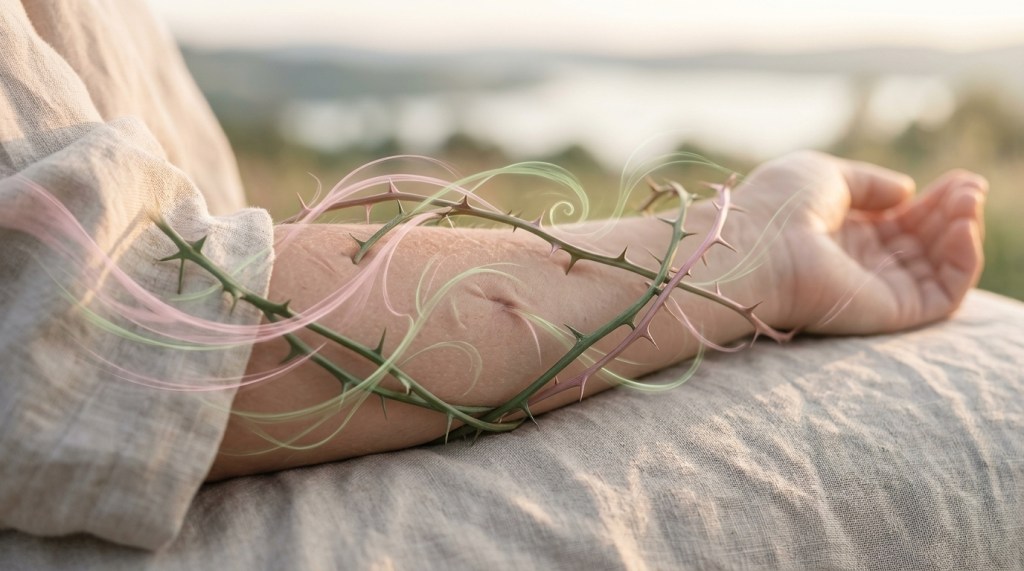
I haven’t written much about my chronic pain journey, and to be honest, that’s because I was being paid to write about inflammatory bowel disease (IBD) and ostomy topics, and that took all of my time and energy for a good few years. While I have recently started writing more about mental health, I think it’s definitely time to play catch up on chronic pain.
I’ve lived with pain for one reason or another since 2007. There were short periods of respite between ulcerative colitis, pouchitis, cuffitis flares, and surgeries, but the majority of my time between 2007 and 2018 involved being in pain. By 2018, I’d begun experiencing symptoms of fibromyalgia (fibro). I was officially diagnosed in September 2020, and other than knowing a lot of people in the chronic illness community who also lived with it, I knew very little.
Before my diagnosis, in the midst of a chronic pain flare
I’m not the kind of person to take things lying down, and I was not going to simply accept being bed-bound, regardless of my body making me feel that way. I’m determined, some would say stubborn, and I was certain I was going to fight my way out of the house!
I’d recently had bowel surgery, and whilst I was used to recovery feeling like it was one step forward and two back (I’d had six bowel surgeries prior), after this particular surgery, the one step forward just wasn’t happening.
The pain was incredible. I knew I should be taking short walks around the block, but making it to the kitchen, on the same floor as the bedroom, felt like a mammoth task. My mental health suffered because being in pain 24/7 does that to a person. I was frustrated, bad-tempered, and often upset.
I’d expected the surgery to be the end of my pain, but within a few months, it spread around my entire body. I experienced widespread muscle and joint pain, light and sound sensitivity, and allodynia, which is when even gentle skin contact feels painful. I felt fragile and pathetic, but I kept pushing, because progress is progress, no matter how minuscule.
Back sprains and daily dog walks
Constant back sprains eventually led me to see a physiotherapist. I had one appointment before the March 2020 COVID-19 lockdowns hit the UK, leaving me to fend for myself. The physio exercises were very basic because my abdominal wall was so weak after seven surgeries. When they stopped being helpful, I looked into beginner core exercises. Seeing that many physio movements mirrored basic yoga postures, I decided to try gentle home yoga practice. I could never have foreseen how much it would benefit my recovery.
Around the same time, we moved into a bungalow without a secure garden. With three dogs needing toilet breaks every couple of hours, I had to take them out. I was overwhelmingly exhausted by it, but forcing myself to do those constant short daily walks proved I could (albeit painfully). So when the garden was secure and I no longer needed to take them for walks, I decided I should continue with one daily walk. They’d loved it, and it made zero sense to lose the ability to do what I had been doing! I just needed to build up slowly and not give up.
Diagnosis, medication, and grieving my old self
When the rheumatologist diagnosed my fibromyalgia in September 2020, he told me I was already doing everything I could to help myself. It was devastating to hear. I was desperately seeking more relief from the daily chronic pain… I asked many questions, and he had very few answers for me. Fibromyalgia remains a poorly understood condition across healthcare. The massive crossover between conditions like myalgic encephalomyelitis (ME), chronic fatigue syndrome (CFS), and hypermobility spectrum disorders makes it complex to navigate.
I knew daily yoga and a 15-minute walk were more than many others with fibro were able to do, but it certainly wasn’t enough to stop me crying at the end of every day because my body hurt so much and it all felt so unfair.
He advised my GP to prescribe nortriptyline, followed by gabapentinoids like pregabalin or gabapentin for pain processing. Nortriptyline did not suit me, so I moved onto gabapentin, slowly adjusting the dose until it offered some control. Yet I still cried at the end of every single day because my body hurt so much.
Going through the stages of grief and acceptance with IBD primed me. Yes, I still undoubtedly went through that process again, but it was a whole lot quicker. It took seven years to reach acceptance after my first bowel diagnosis, but less than a year with chronic pain.
An introduction to modern pain science
In March 2021, a friend shared a video called Healing Our Pain Pandemic featuring pain specialist Dr Rachel Zoffness. That sent me down the rabbit hole of the biopsychosocial model of pain management. I wanted to dive deeper into chronic pain science and start actioning things immediately!
I learned more about pain science in that single hour than from years of medical appointments. Everything I thought I knew about pain, that I’d learnt from healthcare professionals, TV and media, and all of the people around me, was being undone. Learning how the nervous system processes pain signals, and how stress, trauma, and environmental triggers amplify physical pain, completely reshaped my perspective.
Slowly but surely, things have continued to improve. It’s been a trial-and-error process, and some things I’ve tried haven’t helped at all. Unfortunately, this is not a one-size-fits-all quick fix. For years, I felt betrayed and let down by my body. Learning to befriend and listen to bodily signals has allowed me to move out of constant fight-or-flight and start regulating my nervous system better.
I dread to think where I’d be today if I hadn’t come across this BioPsychoSocial approach! I hope to explore some somatic tools and pain science strategies that helped me progress in future posts 💜✨