Have you ever noticed that during periods of high stress or when old memories resurface, your physical pain seems to flare up, too? For a long time, the medical world treated Post Traumatic Stress Disorder (PTSD) and chronic pain as two separate issues that just happened to “hang out” together.
However, a major analysis trending this February (originally published on 22 January 2026) has found that the connection is much deeper than we thought. It turns out that for those of us living with chronic pain conditions, our brains might be using the exact same “wiring” to process both trauma and pain.
The jargon buster: Mapping the brain
To understand this study, we need to break down some of the terms researchers are using to describe our internal experience:
- fMRI (functional Magnetic Resonance Imaging): This is a type of brain scan that shows blood flow. It basically allows scientists to see which parts of the brain “light up” in real time when we feel pain or recall a traumatic memory.
- Neurobiological substrates: This is just a clinical way of saying “the physical building blocks.” The study found that PTSD and chronic pain aren’t just similar “feelings”; they share the same physical foundations in the brain.
- Mesocorticolimbic circuit: This is the big one. It is often called the “reward circuit” of the brain. It is the system that manages dopamine and tells us when something is good or bad.
Why the reward circuit matters for your pain
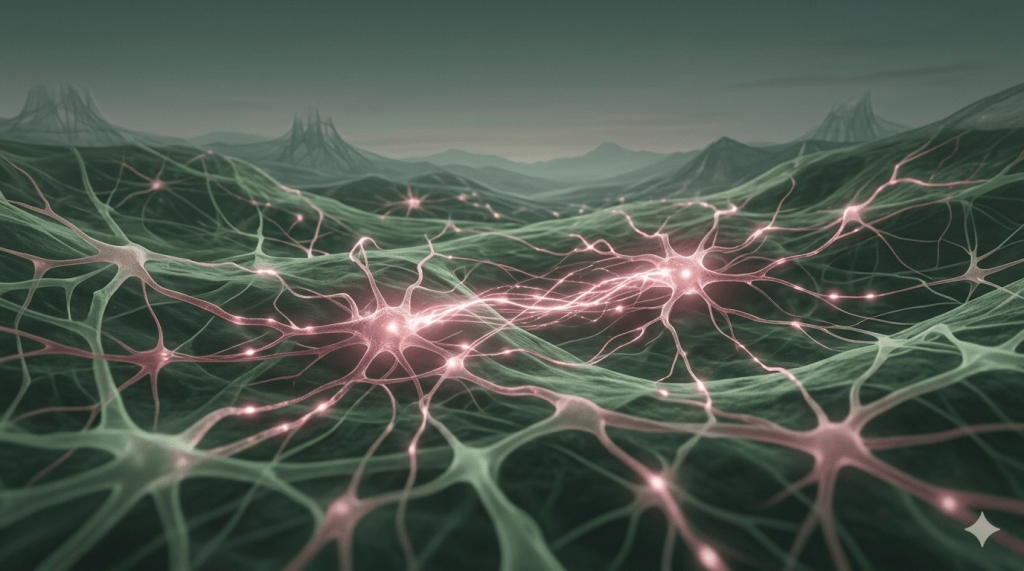
The most fascinating part of this research is that both PTSD and chronic pain hijack the Mesocorticolimbic circuit. Usually, this circuit helps us feel pleasure or motivation. But in people with both PTSD and chronic pain, this system becomes dysregulated. Instead of helping us process rewards, it becomes hyper-focused on survival and threat.
The takeaway: This research proves that trauma doesn’t just affect pain. It uses the same neural pathways. If you feel like your trauma and your physical symptoms are “one and the same,” science agrees with you.
Moving away from “It is all in your head”
For years, patients have been told that their pain is psychosomatic (caused or significantly worsened by mental factors), which often feels like a dismissive way of saying we’re making it up. This study changes that.
By identifying these shared neurobiological substrates, we move into a space of validation. It shows that the mental toll of trauma and the physical toll of IBD or Fibromyalgia are physically linked in the brain’s architecture. We aren’t “sensitive” or “weak” – our brains have been physically recalibrated by what we have been through!
How are you doing with this news?
When we talk about how trauma affects pain, it can feel overwhelming. But I see this as a huge win for advocacy. The more we understand these shared signatures, the better our treatments can become. We can move away from just treating individual symptoms or conditions and start treating the whole, interconnected system.
Does this link between trauma and your physical flares resonate with you?
Please remember that you are navigating a complex biological map every single day. You are doing a brilliant job, and your pain, in all its forms, is real and valid. 💜
 Sahara Fleetwood-Beresford | Patient Advocacy