What is Breathwork?
Breathwork consists of different breathing patterns and/or exercises. It has many scientifically backed benefits, some of which we will explore later.
Why am I dedicating an article to breathing?
Because I’ve personally experienced so many benefits, I believe I’d be doing a disservice if I didn’t share some thoughts and tools, to allow others to benefit, too! For me, connecting to my breath is a very grounding experience. It’s calmed me out of many panic attacks. Plus, focusing on my breathing finally allowed me to break out of an incredibly long insomnia cycle, several years ago.
Simply put, I love breathwork, because it’s accessible to ALL of us, all of the time.
This article will focus on the breathwork you can do at home, but there are also many different types of breathwork classes and sessions you can attend in person.
A word of caution
If you’re attending a breathwork class, in-person or online, make sure you know the purpose of these sessions before you sign up. Some will tackle things like stress, anxiety, or chronic pain, whereas others may be part of more spiritual practices. Some may cause hallucinations, tremors, kundalini experiences etc., which could be really alarming if you’ve just gone for a bit of stress relief!
A friend of mine went to a Holotropic Breathwork class. Holotropic Breathwork is a breathwork technique that involves rapid, rhythmic breathing for 20–60 minutes. It was created as a drug-free alternative to LSD and is intended to induce an altered state of consciousness. To say she was destabilised would be an understatement. It took days for her to ground herself and feel OK again, and left her too anxious and afraid of anything breathwork-related for a long time after.
Breathwork benefits
For many years, studies have confirmed breathing exercises can help alleviate stress, depression, and chronic pain. This is something I’ve only now realised because things like meditation, breathwork, and yoga have become more mainstream in recent years. I’ve got so many links to research articles, but I’ll pop them at the bottom of this post as I realise they won’t be of interest to everyone. The interesting links section just reiterates how powerful a tool breathwork can be, and it covers positive outcomes in a range of situations and conditions such as inflammatory bowel disease, fibromyalgia, heart disease, hypertension/high blood pressure, chronic kidney disease, diabetes, asthma, hot flashes, post-traumatic stress disorder (PTSD), generalised anxiety disorder, and chronic back pain.
I actually find it really disappointing, and quite distressing, that research has been highlighting breathing techniques can improve the quality of life for so many people, and so many conditions, yet our doctors don’t share this information. Instead of being taught how to breathe as a pain management technique, for example, I was just prescribed pain medications. Instead of breathing techniques being taught for anxiety and depression, we’re usually prescribed medications that impact more than just our ability to feel the anxiety or depression, but also blunt our ability to feel joy and happiness. If we’re taught tools we can use to manage our conditions ourselves, we ultimately cost the healthcare system less money. It’s not rocket science! Anyway, I’ll end my little rant there.
One of the main mechanisms is thought to be because breathing techniques can influence the balance between the parasympathetic and sympathetic nervous systems (the autonomic nervous system), leading to relaxation and stress reduction.
The autonomic nervous system
The parasympathetic and sympathetic nervous systems are part of the autonomic nervous system. The autonomic nervous system regulates involuntary functions like heart rate, digestion, and respiration. It is also involved in regulating inflammation and the immune system! Check out The role of the autonomic nervous system in inflammatory and immune conditions.
Sympathetic Nervous System – “Fight or Flight”
- Prepares the body for stressful situations by triggering the “fight or flight” response.
- Increases heart rate, dilates pupils, slows digestion, and releases adrenaline.
- Heightens alertness and energy, readying the body for action.
Parasympathetic Nervous System – “Rest and Digest”
- Calms the body after stress and helps conserve energy.
- Slows heart rate, increases digestion, and promotes relaxation.
- It is responsible for resting, repairing, and digesting functions in the body.
The phrenic nerve controls the movement of the diaphragm and is connected to the vagus (parasympathetic) nerve. Slowing down our respiration rate activates the parasympathetic nervous response while suppressing the sympathetic nervous one.
I hope, by now, I may have persuaded you to try a few breathing exercises for yourself.
Breathing techniques
Here’s a non-exhaustive list you can try at home (instruction provided by Perplexity.ai, so do hop along to YouTube tutorials). I really want to know how you get on, if you try any!
Diaphragmatic Breathing (Belly Breathing)
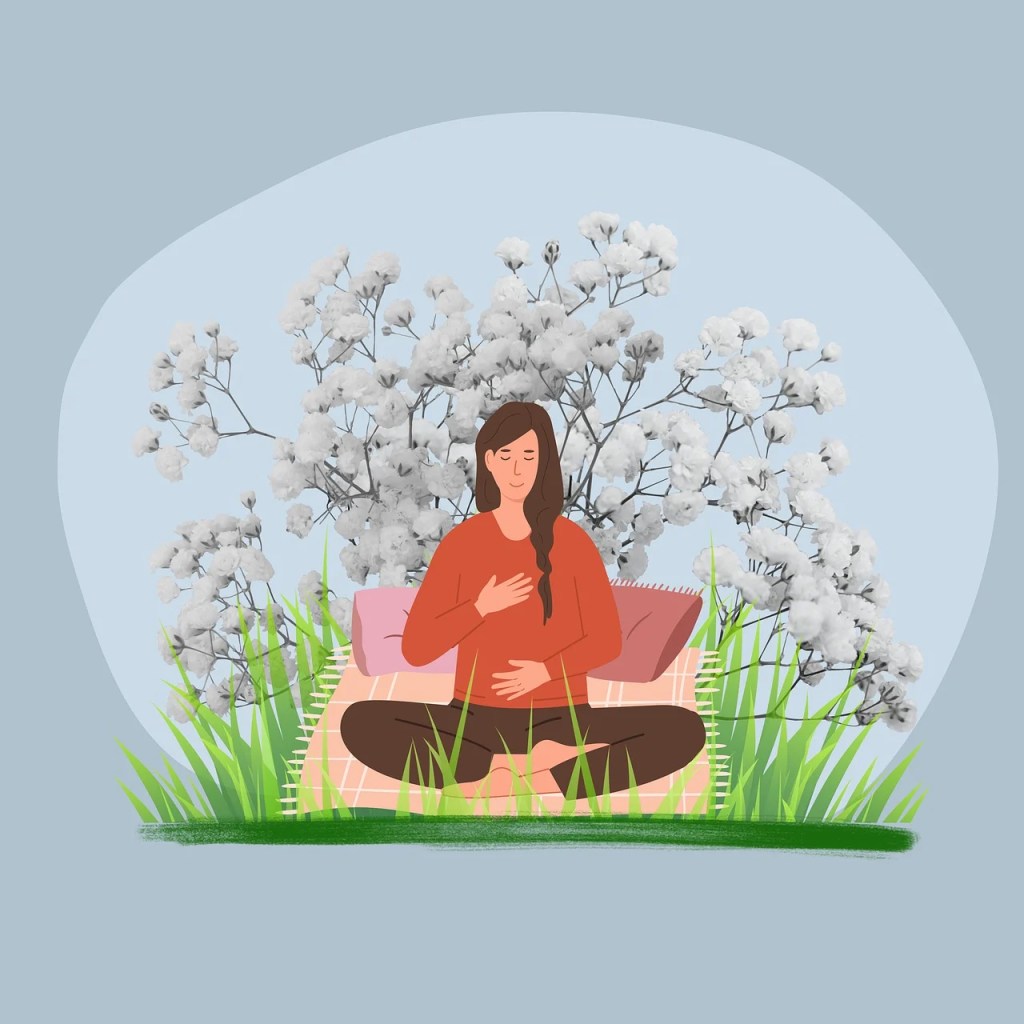
Instructions: Place one hand on your chest and the other on your belly. Inhale deeply through your nose, filling your belly with air. Exhale slowly, fully emptying the belly of air.
Nadi Shodhana (Alternate Nostril Breathing)
Instructions: Use your right thumb to close the right nostril and inhale through the left. Close the left nostril with your ring finger, and exhale through the right. Inhale right, exhale left. This completes one cycle. Continue.
Ujjayi (Ocean’s Breath or Victorious Breath)
Instructions: Inhale and exhale through the nose while slightly constricting the throat (as though you’re trying to fog up a window. This should create an oceanic sound. Keep your mouth closed throughout.
Kapalabhati (Skull Shining Breath)
Instructions: Begin with a deep inhale, then exhale forcefully through the nose while pulling the navel towards the spine. These need to be very short, sharp exhales, one after the other. Allow the inhale to happen passively.
Bhastrika (Bellows Breath)
Instructions: Sit comfortably. Inhale forcefully through the nose while raising your arms, then exhale forcefully through the nose while lowering your arms.
Dirga (Three-Part Breath)
Instructions: Inhale in three parts: first into the lower belly, then the ribcage, and finally the upper chest. Exhale in reverse order.
Shitali (Cooling Breath)
Instructions: Curl your tongue into a tube. Inhale through the tongue tube, close your mouth, and exhale through your nose.
Brahmari (Humming Breath)
Instructions: Inhale deeply through the nose, then exhale while making a humming sound with your mouth closed.
Surya Bhedana (Solar Breath)
Instructions: Close your left nostril with your ring finger, inhale through the right nostril. Close both nostrils, hold briefly, then exhale through the left nostril.
Thoracic Breathing
Instructions: Place your hands on your ribcage. Inhale, focusing on expanding your ribcage laterally. Exhale, allowing the ribs to contract.
Lion’s Breath
Instructions: Inhale deeply through the nose. Open your mouth wide, stick out your tongue, and exhale forcefully while making a “haaaa” sound.
Straw Breath (Pursed-lip Breathing)
Instructions: Take a deep breath through your nose, purse your lips as if holding a straw (or use an actual straw), and exhale slowly and gently through the pursed lips or straw.
Shamanic Breathwork
Instructions: Lie down comfortably. Breathe deeply and rapidly through the mouth, focusing on the inhale and allowing the exhale to be passive.
The Wim Hof Method
Instructions: Take 30-40 deep breaths, inhaling through the nose and exhaling through the mouth. After the last exhale, hold your breath as long as possible. Take one deep breath and hold for 15-20 seconds.
4-7-8 Breathing
Instructions: Inhale through your nose for 4 seconds, hold for 7 seconds, and exhale through your mouth for 8 seconds.
Box Breathing
Instructions: Inhale for 4 seconds, hold for 4 seconds, exhale for 4 seconds, hold for 4 seconds.
Interesting links
Let’s take a look at some science, shall we?
Relaxation techniques: Breath control helps quell errant stress response, 2024, was published in the Harvard Health Publishing (Harvard Medical School).
Effects of a respiratory functional training program on pain and sleep quality in patients with fibromyalgia, 2017, concluded that the 8-week breathing exercise intervention reduced pain, improved global sleep quality, sleep duration, sleep efficiency and sleep latency in patients with fibromyalgia.
The Effect of Breathing, Movement, and Meditation on Psychological and Physical Symptoms and Inflammatory Biomarkers in Inflammatory Bowel Disease (IBD), 2015. In patients with IBD, participation in the Breath-Body-Mind Workshop (BBMW) was associated with significant improvements in psychological and physical symptoms, quality of life, and C-reactive protein. Mind-body interventions, such as BBMW, which emphasize Voluntarily Regulated Breathing Practices, may have significant long-lasting benefits for IBD symptoms, anxiety, depression, quality of life, and inflammation.
RESPeRATE: nonpharmacological treatment of hypertension, 2011, showed slowed breathing was helpful in treating hypertension.
Effect of diaphragmatic breathing on heart rate variability in ischemic heart disease with diabetes, 2009, concluded regular practice of diaphragmatic breathing significantly improves heart rate variability with a favourable prognostic picture in ischemic heart disease patients who have diabetes.
Effectiveness of a Breathing Training Program on Quality of Life in Patients with Predialysis Chronic Kidney Disease: A Randomized Controlled Trial, 2020, says Breathing training program improves QOL in patients with predialysis CKD.
Combination of diaphragmatic breathing with therapeutic walking exercise to increase peak expiratory flow rate in asthma patients, 2022, shows diaphragmatic breathing and therapeutic walking exercise significantly increased the peak expiratory flow in asthma patients.
Effects of Diaphragmatic Breathing on Health, 2020, says diaphragmatic breathing (DB) may be beneficial for reducing both physiological and psychological stress and could improve the respiratory function and respiratory muscle strength. DB may help in treating eating disorders, chronic functional constipation, hypertension, migraine, and anxiety, as well as the QoL of patients with cancer and GERD and the cardiorespiratory fitness of patients with heart failure.
Paced breathing compared with usual breathing for hot flashes, 2013, says participants in all arms reported hot flash reductions during the 9 weeks.
Effects of a yoga breath intervention alone and in combination with an exposure therapy forpost-traumatic stress disorder and depression in survivors of the 2004 South-East Asia tsunami, 2010, concluded Yoga breath-based interventions may help relieve psychological distress following mass disasters.
A multicomponent yoga-based, breath intervention program as an adjunctive treatment in patients suffering from generalized anxiety disorder with or without comorbidities, 2012, results suggest that the Sudarshan Kriya Yoga (SKY) course represents a potentially valuable adjunct to standard pharmacotherapy in patients with generalised anxiety disorder.
The effects of slow breathing on affective responses to pain stimuli: an experimental study , 2010, states that compared to normal breathing, slow breathing reduced ratings of pain intensity and unpleasantness, particularly for moderately versus mildly painful thermal stimuli.
Randomized, controlled trial of breath therapy for patients with chronic low-back pain, 2005, concluded that patients suffering from chronic low-back pain improved significantly with breath therapy. Changes in standard low back pain measures of pain and disability were comparable to those resulting from high-quality, extended physical therapy. Breath therapy was safe. Qualitative data suggested improved coping skills and new insight into the effect of stress on the body as a result of breath therapy.
The Effect of Deep and Slow Breathing on Pain Perception, Autonomic Activity, and Mood Processing—An Experimental Study, 2012, results suggest that the way of breathing decisively influences autonomic and pain processing, thereby identifying deep and slow breathing in concert with relaxation as the essential feature in the modulation of sympathetic arousal and pain perception.
Sudarshan Kriya yogic breathing in the treatment of stress, anxiety, and depression: part I-neurophysiologic model, 2005, says Sudarshan Kriya yoga (SKY), a sequence of specific breathing techniques (ujjayi, bhastrika, and Sudarshan Kriya) can alleviate anxiety, depression, everyday stress, post-traumatic stress, and stress-related medical illnesses. Mechanisms contributing to a state of calm alertness include increased parasympathetic drive, calming of stress response systems, neuroendocrine release of hormones, and thalamic generators.
Sudarshan Kriya Yogic breathing in the treatment of stress, anxiety, and depression. Part II–clinical applications and guidelines, 2005, shows there is sufficient evidence to consider Sudarshan Kriya Yoga to be a beneficial, low-risk, low-cost adjunct to the treatment of stress, anxiety, post-traumatic stress disorder (PTSD), depression, stress-related medical illnesses, substance abuse, and rehabilitation of criminal offenders. SKY has been used as a public health intervention to alleviate PTSD in survivors of mass disasters.
Does the Wim Hof Method (WHM) have a beneficial impact on physiological and psychological outcomes in healthy and non-healthy participants?, 2024, shows promising use of WHM in the inflammatory response category, and suggests future studies should further investigate the benefits of WHM in non-healthy participants with inflammatory disorders.
 Sahara Fleetwood-Beresford | Patient Advocacy
[…] take my medications, go to therapy, exercise, and use complementary therapies such as aromatherapy, breathwork, yoga, TRE (tension & trauma releasing exercises), and spend time in nature. I’ve tried a […]
LikeLike
[…] and Stress Reduction: Practices such as meditation, yoga, and deep breathing exercises can be […]
LikeLike