Part 1 was getting really long, so I had to split my experience of the pain management programme into two parts. Let’s continue where we left off and get this finished!
Pain management programme week five – How pain affects our emotions
📚 Homework is a questionnaire about sleep, a leaflet about the emotional impact of pain, and a relaxation video.
I actually missed part of the session due to a medical appointment, which I was pleased about. I suspected it would be a repeat of the previous sessions, in that the moderators would be going through the homework. I was right, and they were still going through it when I arrived 30 minutes late.
They were going through sleep hygiene tips, which ironically, I had just written a blog about, so it was all fresh in my mind. I’ve spent a lot of time focusing on getting a better night’s sleep. Sleep not only impacts my experience of pain, but it also ties into IBD management. Everyone was talking about how and why they struggled to sleep. I, however, talked about the things I’d been doing to improve mine.
There wasn’t much time left to talk about the emotional impact of pain, so we covered what self-soothing is and were all asked to share what soothes us. This was made into a list and shared with participants after the session.
I zoned out quite a lot during the session, to be honest, feeling like I needed to protect my own mental health. I also felt better about managing to inject some positivity when I did talk.
Pain management programme week six – Compassion-focused therapy
📚 Homework is a self-compassion in chronic pain booklet, another leaflet on the emotional experience of pain, Mindfulness Meditation 3 Minute Breathing Space, and four pages of the pain education guidebook (stress related).
I’m not an idiot. I know chronic pain leads to psychological struggles and stress and vice versa. I know how negative emotions feed into how we experience pain. I KNOW that pain is a biopsychosocial problem. I’ve had this in mind the entire time I’ve been trying to learn how to manage it. So all of the focus on stress, emotions and self-soothing etc, that I’m already doing, I just find frustrating. This programme is the complete opposite end of the spectrum to soothing, for me!
Then there’s self-compassion. I’m by no means perfect, and I have to make a conscious effort to be better at it, but I’m always working at it.
Of course, the session was us covering the homework, and there was a brief Q&A with participants about the things that “drive” us, in correlation with the list of things that soothe us that we talked about last week.
Yet again, a pointless session for me. I’m just pleased we only have two sessions left!
Pain management programme week seven – Returning to things that we value
📚 Homework is a leaflet about the immune system and chronic pain.
You guessed it, we have to go through the homework again. Most of the session is about how the immune system and the nervous system are connected, and how our body and brain react to what they perceive as a threat. Then we discuss the types of things that our brain might be perceiving as a threat, personally. The moderators actually refer the other participants to a video that I previously sent them.
For some reason, I feel like this is the most positive and interactive session yet, despite it being focused on negativity/threats. I find myself wondering if this is because the other participants are most comfortable when talking about these things.
One more session to go!
Pain management programme week eight – Bringing everything together
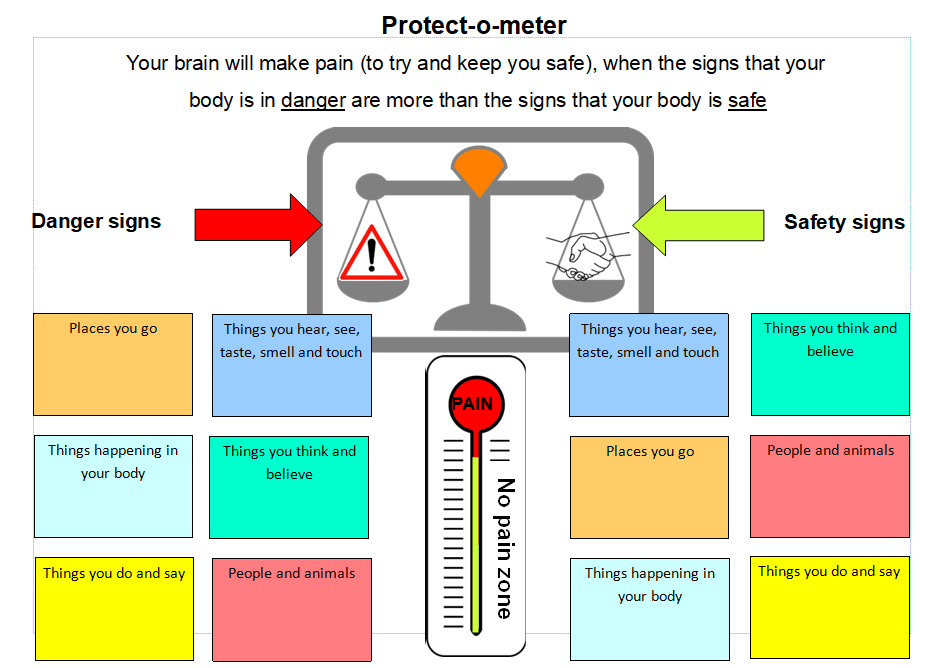
📚 Retake the pain quiz, fill in the mental health and pain score assessment again, and a protect-o-meter image.
I note that my pain quiz answers are exactly the same as before I attended the course (they’re all correct in case you were wondering). I also notice that my pain scale is actually slightly higher than before I started…
The final session recaps everything we’ve covered in previous sessions and we take a look at the protect-o-meter and add our own examples. I will add the blank protect-o-meter as the image for this post at the end.
Finally, the moderators want to know if everyone feels they’ve benefitted from the sessions. They say they will be in touch to chat with us all individually about how we found the sessions soon. Everyone’s feedback is positive. I state that I think sessions like these are good because they let people know they’re not alone, and that I believe educating yourself about your condition is always a good first step to being able to manage it. From a personal perspective, I’m disappointed because I don’t think I actually learnt anything at all. I think I should save the rest for our private call.
And that’s it. It’s all over.
Feedback on the pain management programme
I had my review a few weeks after the sessions had finished, and I fed back very honestly. I will finish the post by repeating the same thing.
I’d said during the initial “sign-up” call that I was hesitant because I don’t like the woe is me attitude. I find it stressful and depressing, and I get annoyed when it’s clear people have made no effort to understand their condition and how to help themselves. I joined a Fibro Facebook group and left pretty quickly because of it. That’s often what the sessions felt like.
Every week, we were sent stuff to watch or read prior to the next session. When we logged on, no one else had done it, so we spent the whole session talking about the stuff people should already have done… That I had already done. Why was I reading it pre-session if we were going to go over it during the session anyway? And we never got to go through very much of it because everyone needed to talk about themselves, and their hardships. A lot of the time, people were asking questions that they would have known the answers to had they actually done the homework they were supposed to do! I was incredibly frustrated.
I think initial assessments and running groups with people who have the same base level of knowledge would be ideal, and much better for the people attending. I think I could have learnt something if we’d actually been able to use the sessions for what they were intended to be used for. There wasn’t really any practical stuff telling you how you can put the science into practice on a day-to-day basis. I wondered whether this would have been part of the programme if everyone had done their homework.
It turns out, this was the first time it had been done in this format, due to budget cuts. In the past, there had been one-to-one calls to go through the materials, and then during the group sessions, everyone was already in the same place.
I’m NOT saying it’s not a worthwhile course for other people. I know most people aren’t like me. It’s probably very educational for many people, and knowledge is power in my opinion. Only when you understand the mechanisms of chronic pain can you begin to take steps to alter it. That said, the science is not for everyone, and it was basically just pain science education. I think there’s a reason people didn’t do their homework every week, and it may have partly been due to not having the interest. And not to sound rude, but some people were obviously not intelligent enough to understand what they were trying to teach anyway.
I’ve been dealing with chronic illness and some form of pain basically since my ulcerative colitis diagnosis in 2007. I’m constantly learning and adapting the way I live my life to achieve the best quality I can. My journey has been long and hard, and of course, I started out like most other people, overwhelmed and negative. It was difficult for me because I was being taken back there every week, and I was frustrated by the constant “I can’t” attitude. I would often interject with personal experience stories with positive outcomes, in the hope that may change their mindset to “maybe, I can“.
In conclusion, it’s a no from me. I could tell that the moderators were frustrated too. It’s a shame for all involved, really. They said there was a question mark about whether the programme would be suitable for me after our initial assessment, and they agreed that I shouldn’t have been on it. I’d gone into it hopeful and came out deflated. One of the moderators was a health psychologist, and she said that she thought I would benefit from it and asked permission to refer me. Of course, I said yes. Still eager and eternally hopeful! I didn’t realise that this feedback session was also going to involve some feedback for me, but, that’s a post for another day!
 Sahara Fleetwood-Beresford | Patient Advocacy
[…] To be continued… […]
LikeLike