Generally speaking, mouth ulcers are much more common in people with Crohn’s disease. That said, life for me is not mouth ulcer-free. In fact, I posted about it just a few weeks ago in the Facebook group I run.
Mouth ulcers are small lesions that develop on the gums, lips, tongue, inner cheeks, or the roof of your mouth. They’re usually round(ish) in shape and somewhere between 2mm and 8mm across. You might get one, clusters of them, or multiple scattered around the inside of your mouth.
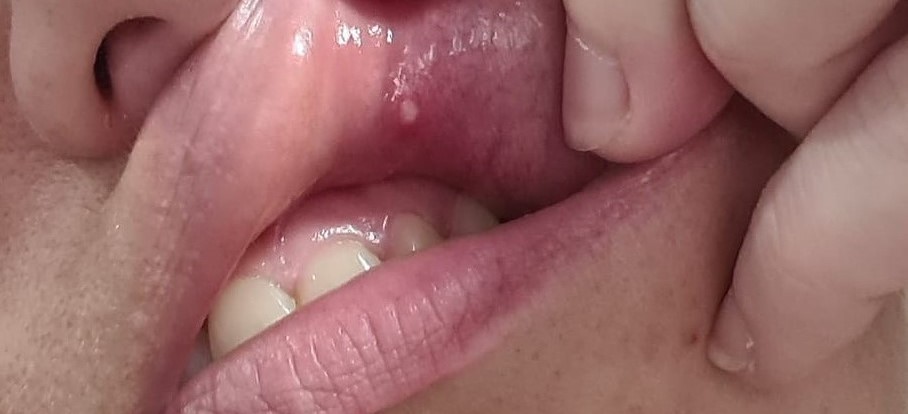
Beware of NSAIDs contributing to mouth ulcers
I don’t suffer from mouth ulcers daily, however, if I allow non-steroidal anti-inflammatory drugs (NSAIDs) near me, they immediately occur.
I hope you’re already aware that NSAIDs are a no-no for people with IBD. I was worried to read, in response to the post I just mentioned, that someone was prescribed them in hospital following surgery on three different occasions. It’s well documented that people with inflammatory bowel disease should avoid NSAIDs because they result in higher rates of symptoms and flare onset. Examples of NSAIDs are; diflunisal, meclofenamate, naproxen, ibuprofen, meloxicam, and diclofenac. A 2021 study suggested that daily aspirin use did not impact major clinical outcomes in patients with IBD. However, it’s worth noting that this was based on reported symptoms and mucosal inflammation was not assessed in this study.
So, for me to allow NSAIDs anywhere near me, I have to be desperate. The trouble is, it’s not uncommon for me to be desperate. I very rarely resort to taking oral NSAIDs, and if I do, like when I had a shoulder injury last year, I stick to aspirin only. However, I live with secondary fibromyalgia (thank you IBD), so widespread pain is a daily problem. I only have limited options for pain relief, and a long, hot bath isn’t always feasible. Fairly regularly, I apply diclofenac gel before bed, so I am comfortable enough to get to sleep. I use as little as possible and only where necessary, but enough gets absorbed to result in me having mouth ulcers. It literally astonishes me; how sensitive I am and how quickly the mouth ulcers occur.
This is a topic I have addressed in the Facebook group before, with many patients reporting that they have no issues and some have even been told by their consultants that applying a gel won’t result in symptoms because not enough of it will be absorbed into the blood stream. However, my personal experience is very different. Some people also say they do take oral NSAIDs with no noticeable problems. As with most things IBD, we’re all different!
As soon as I feel that familiar sting, I’m off to the bathroom to see whether I’ve just caught my mouth eating or whether I have an ulcer. I usually already know the answer, based on whether I’ve needed to use the gel or not!
It’s incredibly frustrating, because in my mind, if I didn’t have IBD, I wouldn’t have ended up with fibromyalgia. If I didn’t have fibromyalgia, I wouldn’t need to resort to using NSAIDs gels so often. If I didn’t have IBD, I wouldn’t be so sensitive to the NSAIDs anyway! It’s madness, and, maddening!
How I treat my mouth ulcers
I’m not sure how many of the things I’m about to mention will be known in different parts of the world. I know TCP is not known in the US, as I was talking to an American friend when I had my most recent ulcers, and she had no idea what it was! Anyway, because it’s a pretty common occurrence, I have my own regimen ready for when mouth ulcers occur. I’ll explain a little about the ingredients and the purpose of each.
- Bonjela. Bonjela is a mouth ulcer gel containing Cetalkonium Chloride, an antiseptic which helps fight infections, and Choline Salicylate (which is an NSAID), for relief from pain and inflammation. It is applied straight onto the ulcer and can be repeated every 3 hours.
- TCP Liquid Antiseptic. This contains halogenated phenols and phenol, which are both antiseptic agents. I dab undiluted TCP onto the ulcers three times a day. I love the stuff, it’s used for everything from cuts and grazes to sore throats (you can gargle with it, diluted).
- Oragel. Oragel is a gel containing Benzocaine, a topical local anaesthetic. I use this just before eating to ease the discomfort. I usually apply it with a cotton bud, so I don’t risk numbing areas I don’t want to numb!
- Gengigel. The active ingredient is sodium hyaluronate, a derivative of hyaluronic acid. It comes as a gel, mouth rinse, and spray, and promotes faster healing. I use the gel daily anyway on my receding gums, but additionally use it when I have mouth ulcers. It can be used up to four times a day, but not before food.
Community tips for dealing with mouth ulcers
Mouth ulcers are a pretty common topic, so I’ve picked up lots of tips from the group over the years. I thought I’d share the most common suggestions here:
- Saltwater gargles
- Bonjela (as mentioned above)
- Anbesol Liquid, which contains Lidocaine hydrochloride for numbing action, and Chlorocresol and Cetylpyridinium chloride for their antiseptic properties. Can be used up to every 3 hours.
- Hydrocortisone buccal tablets. Each tablet contains 2.5mg of hydrocortisone. Hydrocortisone is a steroid (also called a corticosteroid). The tablets relieve the soreness of mouth ulcers and speed up healing. The tablets stick to the inside of your mouth and release hydrocortisone as they dissolve. You can use 4 tablets a day for up to 5 days, with 3 – 4 hours between doses.
- Difflam, which contains benzydamine hydrochloride; a locally acting analgesic and anti-inflammatory treatment. It comes as a mouthrinse and spray and can be used every 1.5 – 3 hours. Ironically, benzydamine is classed as an NSAID.
Tell me, do you suffer from regular mouth ulcers, and what are your top tips for dealing with them?
 Sahara Fleetwood-Beresford | Patient Advocacy